
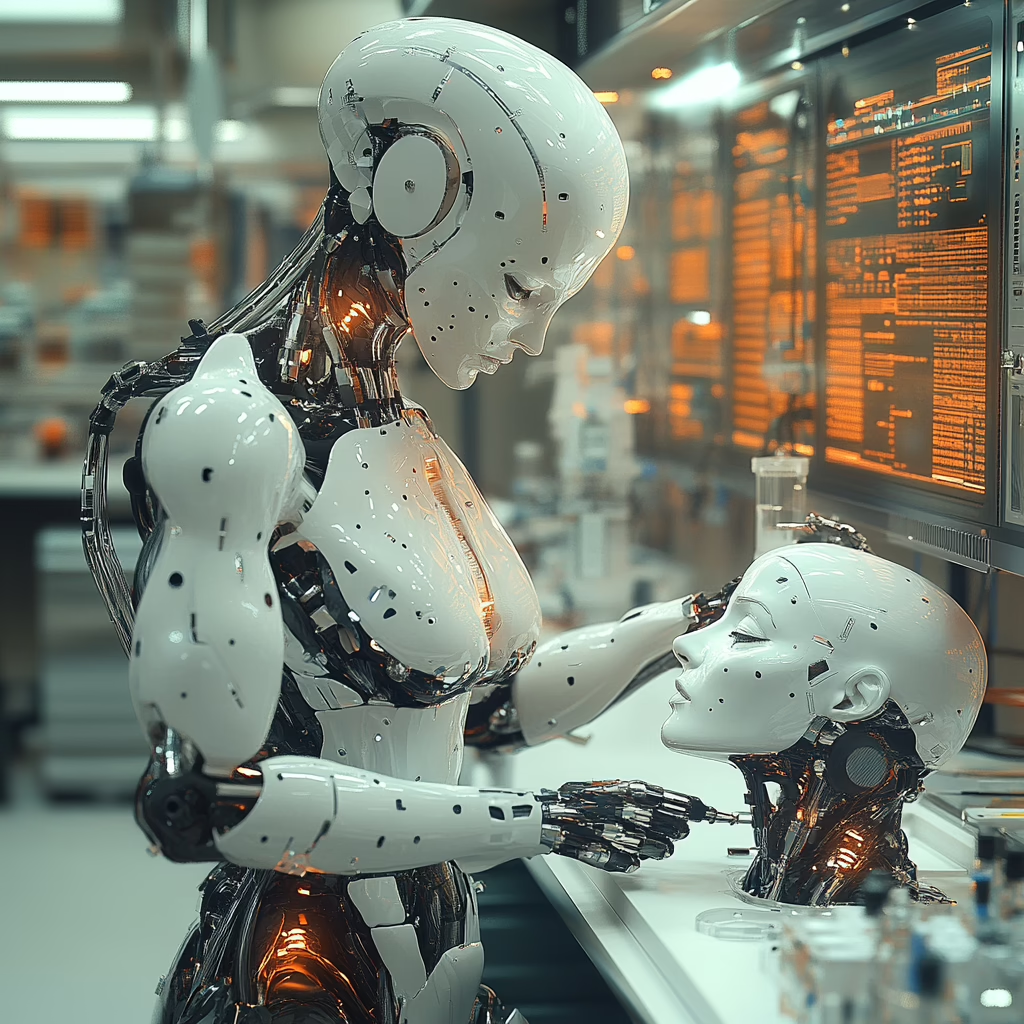
Technological evolution has always aimed to reduce human involvement in the most repetitive and labor-intensive tasks, allowing people to focus on more creative and strategic activities. This evolutionary law is often underestimated and reduced to the concept of simple automation. However, it represents a fundamental TRIZ principle of technological innovation and the ongoing digital transformation.
From Mechanical Automation to Artificial Intelligence
In the past, the reduction of human intervention relied on mechanical systems and simple automations. Today, the real revolution is driven by Artificial Intelligence (AI). Modern machine learning and deep learning algorithms enable machines to learn, make decisions, and perform tasks autonomously, reducing the need for human supervision.
Concrete Examples:
- Laundry: Transition from manual washing with a tub and washboard to semi-automatic washing machines with wringers, and finally to modern fully automated washing machines with smart programs and sensors optimizing water and detergent consumption.
- Autonomous Driving: Advanced Driver Assistance Systems (ADAS) are rapidly evolving towards fully autonomous vehicles, reducing the need for human intervention and enhancing road safety.
- Industrial Automation: Factories are adopting collaborative robots (cobots) capable of performing complex tasks without continuous supervision, increasing productivity and reducing human error.
Artificial Intelligence and the Transformation of Work
AI is not limited to industry but is revolutionizing multiple sectors by drastically reducing human involvement in repetitive tasks.
- Financial Services: Automated trading algorithms analyze markets and make investment decisions in milliseconds, reducing the need for human traders.
- Healthcare: Diagnostic AI supports doctors in identifying diseases through medical imaging and patient data analysis, accelerating diagnoses.
- Customer Service: Chatbots and virtual assistants, such as those based on GPT, are replacing human operators in basic customer interactions, improving response times and reducing operational costs.
Reduction of Human Involvement and New Interaction Paradigms
Reducing human intervention does not necessarily mean eliminating the role of people but rather transforming it.
- From Labor to Supervision: Many manual tasks are shifting towards monitoring and optimization activities. For example, traditional vehicle driving is transitioning into the automated supervision of autonomous vehicle fleets.
- From Repetition to Creativity: Generative AI tools enable automation in writing, design, and even programming, freeing time for more strategic and creative activities.
The Future of Technological Evolution
To anticipate future developments, it is essential to consider all TRIZ evolutionary laws. In particular, the reduction of human intervention will continue to advance in key sectors such as:
- Agriculture: Drones and IoT sensors will monitor fields and optimize water resources without intensive manual labor.
- Construction: Construction robots and 3D printing for buildings will enable infrastructure development with minimal worker involvement.
- Education: AI is already personalizing learning paths, reducing the teacher’s role in basic activities and shifting it towards a more strategic mentorship role.
Conclusion
The evolution towards the reduction of human involvement is an unstoppable process that is transforming every sector. Artificial Intelligence, robotics, and intelligent automation are redefining the role of humans in the workforce, freeing them from repetitive tasks and opening new opportunities for creativity, innovation, and quality of life improvement.
The future of technological innovation will not only be defined by reducing human intervention but also by creating a balance between automation and supervision, ensuring efficiency without losing the value of human ingenuity.